
Particle Wars: は vs. が
“You cannot simultaneously prevent and prepare for war.” - Albert Einstein
In the previous season, we learned how to use the particle は. It wasn’t so bad, right? In this chapter, we’re going to add が to the equation. You don’t know it yet, but は just got a lot more confusing. It’s not that they’re particularly hard to use, but their similarities make it difficult to discern which one you should use in which situation. Even their definition is the same. After that, it’s all about nuance.
は and が indicate subjects by coming after them.
When I say “subject,” I am referring to the “topic” of a conversation. Take a look at the following sentences. The subject has been bolded to give you an idea of what a “subject” in a sentence is:
- The tree is green
- The dog that ate the cat is back
- My friend who saw the ghost last night is staying at our house tonight
Do you remember the different things は can be translated to? Is… am… are…? Look at the sentences above again, and then re-read the definition of は and が. These particles indicate subjects (the parts that are bolded above) by coming after them (in these sentences, our particle is “is”).
- The tree is green
- The dog that ate the cat is back
- My friend who saw the ghost last night is staying at our house tonight
So far so good? Now for the confusing part. Here’s the “nuance.”
は emphasizes what comes after it.
が emphasizes what comes before it.
Just remember this for now. There’s a better explanation coming:
NO, SHOOT HIM!
I’M THE REAL KOICHI!
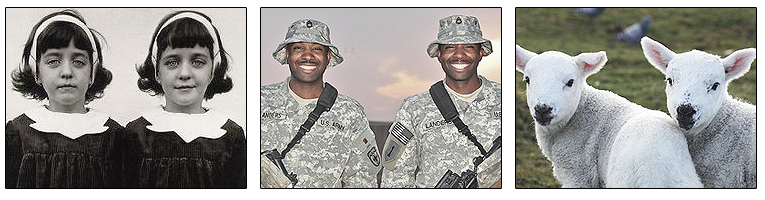
It’s rainy. You’re on the top of a sky scraper, pointing a gun at two identical versions of your brother. One of them, you know, is a murderous alien that doesn’t want to get killed. Shapeshifting. You have to make the decision and pull the trigger. Which one will it be? “No, kill him! I’m the real Koichi! Shoot him, shoot him!”
We’ve all been in this situation. Alien shapeshifter, gun, 50/50 chance… you know the drill. In every situation like that, you’ll find this line:
“I’m Koichi.”
“No I’m Koichi. (shoot him!)”
This is exactly how we’re going to learn the difference between は and が. Corny, right? Hopefully very effective as well. Let’s take a look at the sentence “I am Koichi.” Do you remember how to write that? Let’s take a look at that sentence, and see it from both the は and が perspectives.
わたし は こういち です。 I am Koichi.
わたし が こういち です。 I am Koichi.
Uh oh, the translation is the same. What’s the difference between these two sentences? The first thing to remember is that は emphasizes what comes after it, and が emphasizes what comes before it. The “important” part of the sentence (i.e. the part that has the emphasis) is highlighted in green.
わたし は こういち です。 I am Koichi.
わたし が こういち です。 I am Koichi.
Let’s take a look at two situations. See if you can figure out which version of the above sentence should be used.
- You are meeting new people and want to introduce yourself. In this case, you would say わたし は こういち です, because the important part of this sentence is your name (you are introducing yourself after all).
- You are in a crowded auditorium, and somebody comes on the loudspeaker: “If your name is Koichi, and you’ve been separated from your mother, please come to the stage now.” In this situation, you would say わたし が こういち です, because the important thing is that you are the Koichi out of all the other possible Koichi’s in the room. The important part isn’t so much the “Koichi” part, it’s the fact that YOU (わたし) are the Koichi they’re looking for.
- You’ve been doing some online dating, and you’re about to meet “Steve,” even though you’ve never seen his picture before. He comes up to you and says わたし は Steve です (I am Steve, where the important part in this sentence is “Steve”). You are surprised, because he’s much more handsome than you thought (his name is Steve, after all), so you respond with あなた が Steveさん ですか. You use が in this sentence, because you’re surprised that this guy is the Steve you’ve been talking to all along. It would be like writing “You’re Steve??!” in English, italicizing the you’re part.
は emphasizes what comes after it.
が emphasizes what comes before it.
Another way to describe it (memorize this one too):
は talks about something.
が identifies something.
This will make more sense as we get into using these particles more. I think you probably know the “important” part of this lesson… The only two things you need to learn before moving on… You’ll have a lot of opportunity to practice these in the coming chapters as we learn more about verbs and adjectives, and it’ll make things easier if you just remember these two things.
Before You Move On:
- Know what side of the sentence は emphasizes.
- Know what side of the sentence が emphasizes.
- Know the difference between わたしはこういちです and わたしがこういちです.